
The Brazilian PASSION FLOWER grows on a vine and looks like something out of


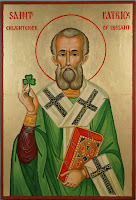
In the 5th century, it is said that SAINT PATRICK used

Joseph is depicted as holding the infant Jesus and a lily signifying purity and joy.
Likewise, in paintings of the Annunciation, Gabriel is often featured as offering a lily to Mary symbolizing the hope to be fulfilled in the new life she will carry: the Promised One, the Messiah.

When Mary visits Elizabeth she sings her Magnificat. Perhaps she also sang from the prophet Sirach, “Listen to me, faithful ones: open up your petals; Send up the sweet odor like incense; break forth in blossoms like the lily. Raise your voices in a chorus of praise; bless the Lord for all God’s works!” Sirach 39:13-14
Lilies are often associated with funerals where they symbolize that the soul of the departed has been received and restored to innocence after death.

“This child is chosen by God for the destruction and the salvation of many in Israel. He will be a sign from God... And sorrow, like a sharp sword, will break your own heart.” Luke 2:34-35
The beautiful and elegant
iris serves as a symbol of faith and valor in the midst of sorrow. Its varied colors of purple represent the
shades of sorrow that touches all our lives and the graces we have received
from God to stand tall and fast like the iris, like Mary.
Every
three years, on the Saturday of the Fifth Week of Ordinary Time (sadly, not
this year, but next year), we hear the story of Adam and Eve’s banishment from the
garden of Eden. But have you heard
about Eve and the SNOWDROPS?
After Adam and Eve had disobeyed God by eating the forbidden fruit they were cast out from paradise by the angel. They sat outside the Garden of Eden in the lonely wilderness where no flowers blossomed and no birds sang. The earth was barren. The trees were without fruits and the grasses were brown and dry. Snow began the fall. Adam and Eve sat and remembered the beautiful greenery and colorful flowers of the garden which had once been their home. Eve shivered in the bitter cold and sobbed. God in heaven looked down and saw Eve weeping. The Most High took pity on her and sent an angel to watch over them. To console Eve, the angel caught a handful of snowflakes, blew on them and ordered them to become flowers once they touched the earth. As the snowflakes came in contact with the earth they sprung up into beautiful white flowers. Eve smiled with joy to see the flurry of snowdrops spring up in the snow. The angel told Eve, "Take heart, dear Eve, be hopeful and despair not. You will be the mother of all the living. Let these little snowdrops be a sign to you that spring and sunshine and life will come again."

We are always happy to find a flurry of
snowdrops in a sheltered corner of the monastery peeking up through the snow in late
Winter. This sign, indeed, is our reason to hope and our salvation.
Gold. Frankincense. Myrrh.

Last year, on the feast of the Epiphany, we celebrated our Sr. Lydia’s 66th anniversary of religious profession; her gift to the church and the world. Sadly, we could not celebrate with her because of covid in the nursing home. Sister had contracted covid and never fully recovered. She was 90. That Christmas, I was inspired to send her a stuffed toy frog and to write a little legend about a coqui from her native Puerto Rico.
THE COQUI’S GIFT
A
bright star blazed in the night sky while under the palm tree slept three wise
kings with their camels. In the palm tree sat a little coqui frog keeping
watch. Silently, he had listened to
their words of wisdom and learned they were on their way to greet the new
king!

With great insight, the three kings said, “Truly, this babe must be the Son of God,” as they humbly bowed before the newborn king and they offered their gifts of gold, frankincense and myrrh.
Sadly, the coqui had nothing to offer.
When nighttime fell, the three magi and the holy parents drowsed and dreamed dreams of the wonders of God’s love. The coqui hopped closer to look at the Holy Child. The babe’s little hand waved and beckoned him closer. The baby king wasn’t sleepy. Neither was the coqui.

I imagine Sr. Lydia enjoyed this story because the Three Kings are a big deal in Puerto Rico and she loved coquis. Sr. Lydia died 3 weeks later. We rejoiced for her, for now she is in heaven singing her own song of wonder and gratitude to Jesus, the King of her heart.
What is the feast of Epiphany all about? Epiphany actually has three manifestations of the presence of God in our midst. The first being the Three Kings. The second is when John the Baptist recognized Jesus for who he truly is at his baptism in the Jordan when a voice from heaven declared, “You are my beloved Son, with whom I am well pleased.” Matt 3:17 And the third Epiphany is at the Wedding Feast of Cana. Unfortunately, this beloved gospel reading only comes up once every three years. Fortunately, this is the year! In changing the water into wine at Cana, Jesus, himself, reveals his glory to the disciples and that of the Father’s abundant mercy and love for humankind. John 2:11
We can ask ourselves today:
Are we like the wise magi seeking Christ the King in our hearts?
Are we like Mary and Joseph welcoming the stranger?
Are we like John the Baptist, preparing the way that others might recognize Christ?
Do we hear the Father say to us, “You are my beloved, with whom I am well pleased?
Or are we like Jesus, using our God-given gifts to spread joy in the knowledge of God’s abundant love and mercy by our words and actions?
We need not be on some quest searching for something difficult to find. We have only to open our hearts to see evidence of God’s love surrounding us. Everywhere and everything has been touched by the grandeur of God’s animating power. Every moment of the day, whether it is something simple, like waking up in the morning, or difficult, like mourning the death of a child, is an occasion of God’s love and compassion.
Can we be an epiphany of God’s love for the world in our own time and place? Jesus believes we can, when he said, “I have given them the glory you gave me, so that they may be one, as we are one, I in them and you in me, . . . that the world may know that you sent me, and that you love them, even as you love me. . . . Father, they are your gift to me.” John 17:21-22, 24
I’ll end with a
story about one of the sisters
I live with. She has dementia. Sister had always been a person with a heart
of love. Now, she can’t hold a
conversation, but is still intent on looking for ways to help others. At Mass, when she goes up to communion, she
says, “Thank you” when the priest places the host in her hands. It is very touching that somehow, she
recognizes the gift of Jesus in the Eucharist.
If the only gift we can offer in the presence of God is a simple, “Thank you, thank you, thank you,” than that gift would be enough.


2021 Advent and
Christmas
Grace and Greetings to all our
Family, Friends and Benefactors,
We gather at this time of year to ponder
the great mystery of Jesus’ Incarnation and in anticipation of Christ’s coming
again in glory.
We cry out, ‘Come, Lord Jesus,’ and sing with all the angelic choirs to the glory of God the Father, ‘Jesus Christ is Lord!’
During this year of continuing
(but easing) covid restrictions, climate disasters, human and political
struggle, we find refuge under God’s protecting wings. We are never without God’s loving mercy,
peace
and joy, with the Holy One lighting our way.
Our year has been quiet
but full. Last Advent, Sr. Moira gave a
reflection during the novena before Christmas on the Redemptorist YouTube
channel, on the Key of David. Our Sr.
Lydia died in January and is now rejoicing with the angels in heaven. Her funeral was live-streamed and her family
in Puerto Rico, and others, were able to join in the celebration of her
life. February came in with a blizzard
of 18 inches of snow and Ash Wednesday soon followed. We received ashes applied with Q-Tips – they
were the most precise crosses on our foreheads ever! In March we rejoiced when we and the
Carmelites received our covid shots. Despite that, we continued to follow the
Archdiocesan protocol and celebrated Holy Thursday, Good Friday and Easter
Vigil without a priest. We missed our
guests who would have joined us for the Triduum. But on Easter morn, we were overjoyed when our
local pastor, Fr. Richard Smith, celebrated Easter Mass with us. What a
blessing! After Pentecost we began to have a few masses
a week but without guests.
In June, Redemptorist Fr.
Ako Walker was able to celebrate a Mass here in honor of our Mother of
Perpetual Help for all your special intentions.
During the summer, Fr. Richard Smith was our honorary Redemptorist when
he celebrated the feast day Masses for Holy Redeemer Sunday on
the Third Sunday of July, St. Alphonsus on August 1 and Blessed M. Celeste on
September 11.
Meanwhile, we held ZOOM
meetings with our Associates, received spiritual direction and attended a
meeting discussing racial issues in religious congregations. We, also, measured
Redemptorists for new habits via Zoom, and Skyped with family and friends.
In June we began a
monthly morning of reflection for our community. It began with a hymn, a short video, a time
for sharing and ended with a prayer on such topics as: How Did You Know: vocation stories, Being a Human Lighthouse,
Are We Angels on Earth, Visions and Dreams of the Dying, and Gratitude.
We, and our Carmelite
Sisters, made our 10-day community retreats together in November. Because neither community had a director,
some of us viewed Season 2 of The Chosen, once- a-day, for eight days. The Chosen tells the story of Jesus and His
followers and, in a powerful way, lends itself to meditation and contemplation.
Our Novena before
Christmas begins December 16. We gather
in Celeste Hall, our community room, around the flickering Advent candles and
pray for all your intentions, saying,
“Adore, oh my soul, in the heart of Mary,
the only begotten Son of God who was made man for love of you.”
Wishing you a blessed and
holy Christmas and New Year as we join the angels sweetly singing:
Gloria in excelsis Deo!


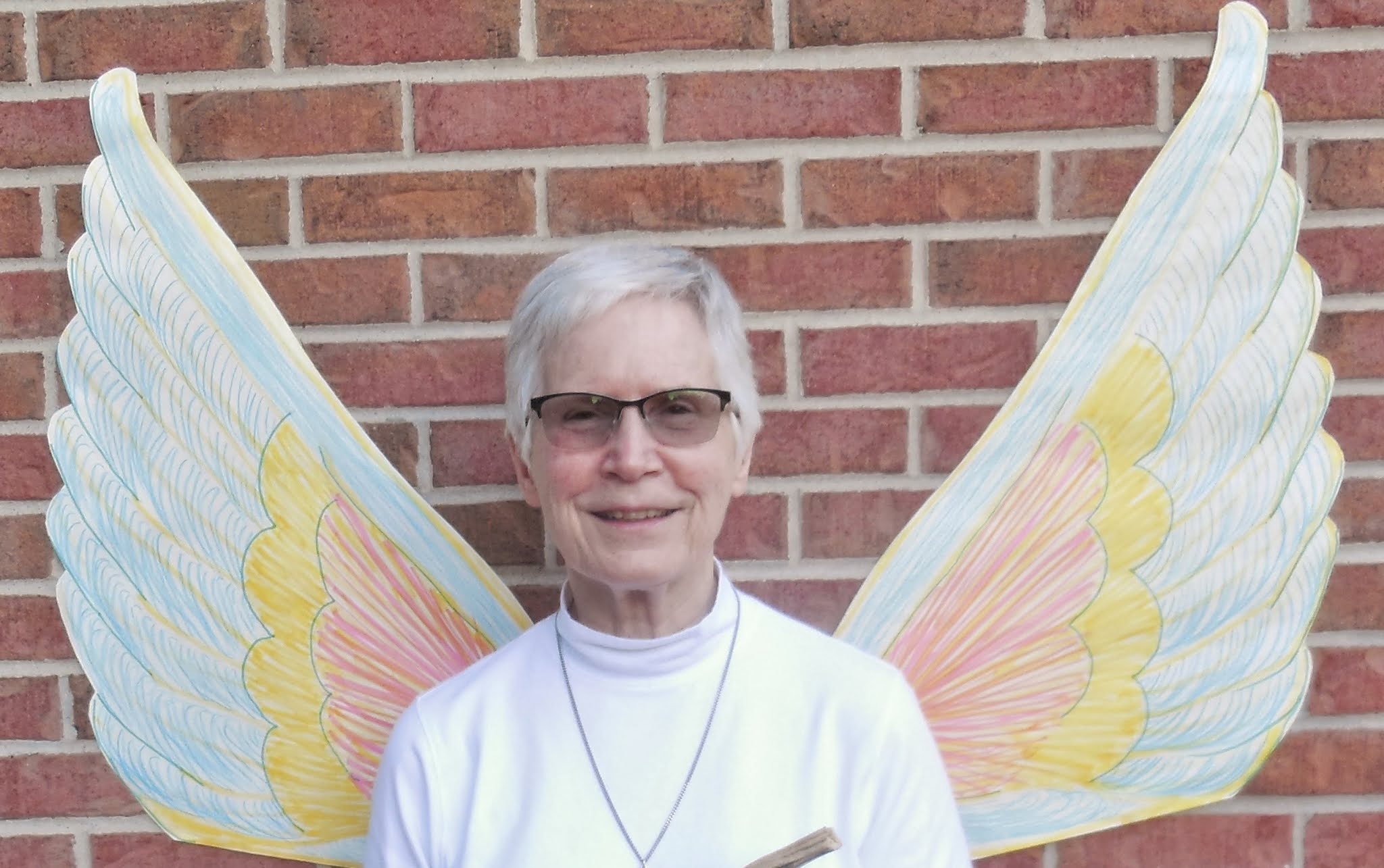

Sr Moira is our Creative Angel keeping our website REDNUNSNY.ORG and Facebook up to date.
